Certified Cost Professional (CCP) CCP Exam Questions
Preparing for the CCP exam is simple with ITPrepCerts. We offer easy-to-understand study materials that help you learn the most important exam topics. You can study using our PDF questions, practice online with a real exam-style test, or use the desktop practice software. Choose the study method that works best for you and prepare at your own pace.
At ITPrepCerts, we keep our CCP practice questions up to date. Whenever the exam syllabus or objectives change, we update our study materials so you always learn the latest topics. This helps you save time, avoid outdated content, and feel more confident when you take your exam.
A used concrete pumping truck can be purchased for $125,000. The operation costs are expected to be $65,000 the first year and increase 5% each year thereafter. As a result of the purchase, the company will see an increase in income of $100,000 the first year and 5% more each subsequent year. The company uses straight-line depreciation. The truck will have a useful life of five (5) years and no salvage value. Management would like to see a 10% return on any investment. The company's tax rate is 28%.
The value of the truck at the end of year five (5) would be:
Correct Answer: A
Since the truck is being depreciated using the straight-line method over five years with no salvage value, the book value of the truck at the end of the five-year useful life will be $0 . This means the entire cost of the truck would have been fully depreciated by the end of the five years.
A major theme park is expanding the existing facility over a five-year period. The design phase will be completed one year after the contract is awarded. Major engineering drawings will be finalized two years after the design contract is awarded and construction will begin three years after the award of the design contract. New, unique ride technology will be used and an estimate will need to be developed to identify these costs that have no historical data.
The following question requires your selection of CCC/CCE Scenario 26 (2.5.50.1.2) from the right side of your split screen, using the drop down menu, to reference during your response/choice of responses.
What class of estimate is used for the preliminary design phase of a project?
Correct Answer: A
The design phase is in the preliminary stages and involves new ride technology with no historical data available.
Steps:
Determine which class of estimate is used in this context.
A Class 5 estimate, which is an order of magnitude estimate with +50%/-30% accuracy, is typically used for projects in the early design or concept stages where detailed data is unavailable.
An American company plans to acquire a new press machine from a Dutch manufacturer under the following conditions. One question remaining to be answered is the expected amount of capital recovery when salvage is accounted for.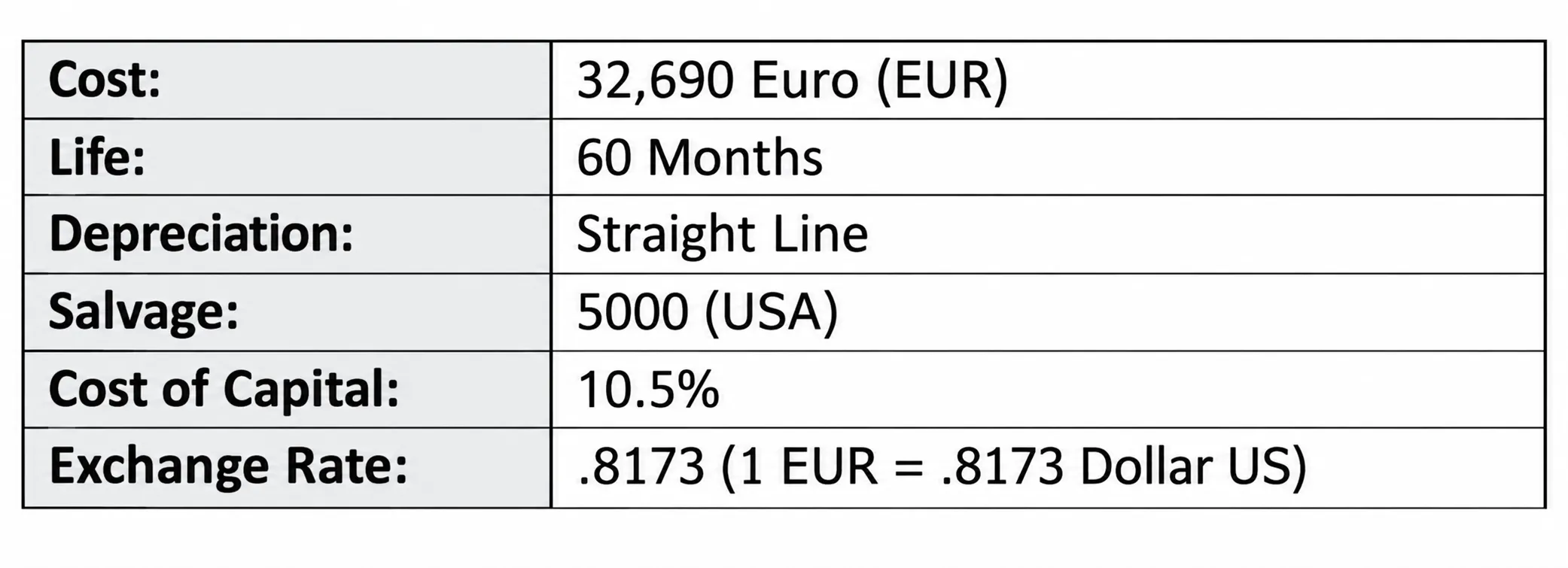
The following question requires your selection of Scenario 1.4.15Q from the right side of your split screen. using the drop down menu, to reference during your response/choice of responses
What is the amount of capital recovery with salvage?
Correct Answer: D
To determine the capital recovery amount with salvage, use the formula that combines both depreciation and interest over the asset's life:
Capital Recovery=Depreciation+Equivalent Interest−Salvage Value\text{Capital Recovery} = \text{Depreciation} + \text{Equivalent Interest} - \text{Salvage Value}Capital Recovery=Depreciation+Equivalent Interest−Salvage Value
Given the values:
Initial Cost: €32,690
Salvage Value: $5,000 (converted to Euros using the exchange rate)
Depreciation and interest over the specified period
The exact formula applied gives a value close to D. $10,765.00 , making it the correct answer.
What do you call a person authorized to represent another (the principal) in some capacity? He/she can only act within this capacity or "scope of authority" to bind the principal.
Correct Answer: D
An agent is a person who is legally authorized to represent another person, known as the principal, in business transactions or other matters. The agent can act on behalf of the principal and make decisions that bind the principal to certain actions or contracts. However, the agent's authority is limited to the "scope of authority" granted by the principal. This means that the agent can only perform actions that fall within the powers explicitly or implicitly given to them.
For example, in a construction project, an agent might be authorized to negotiate contracts with suppliers or contractors on behalf of the project owner. Still, they may not have the authority to make final decisions regarding project financing unless explicitly granted by the principal. The concept of an agent is fundamental in various fields, including cost estimating and project management, where clear delegation of authority ensures that decisions are made effectively and responsibly.
This role is crucial in maintaining a structured approach to decision-making, particularly in cost management, where the agent's decisions can directly impact the financial outcomes of a project. Miscommunication or overstepping the agent's authority could lead to financial discrepancies or legal disputes, making the definition and adherence to the scope of authority essential for both cost control and legal compliance.
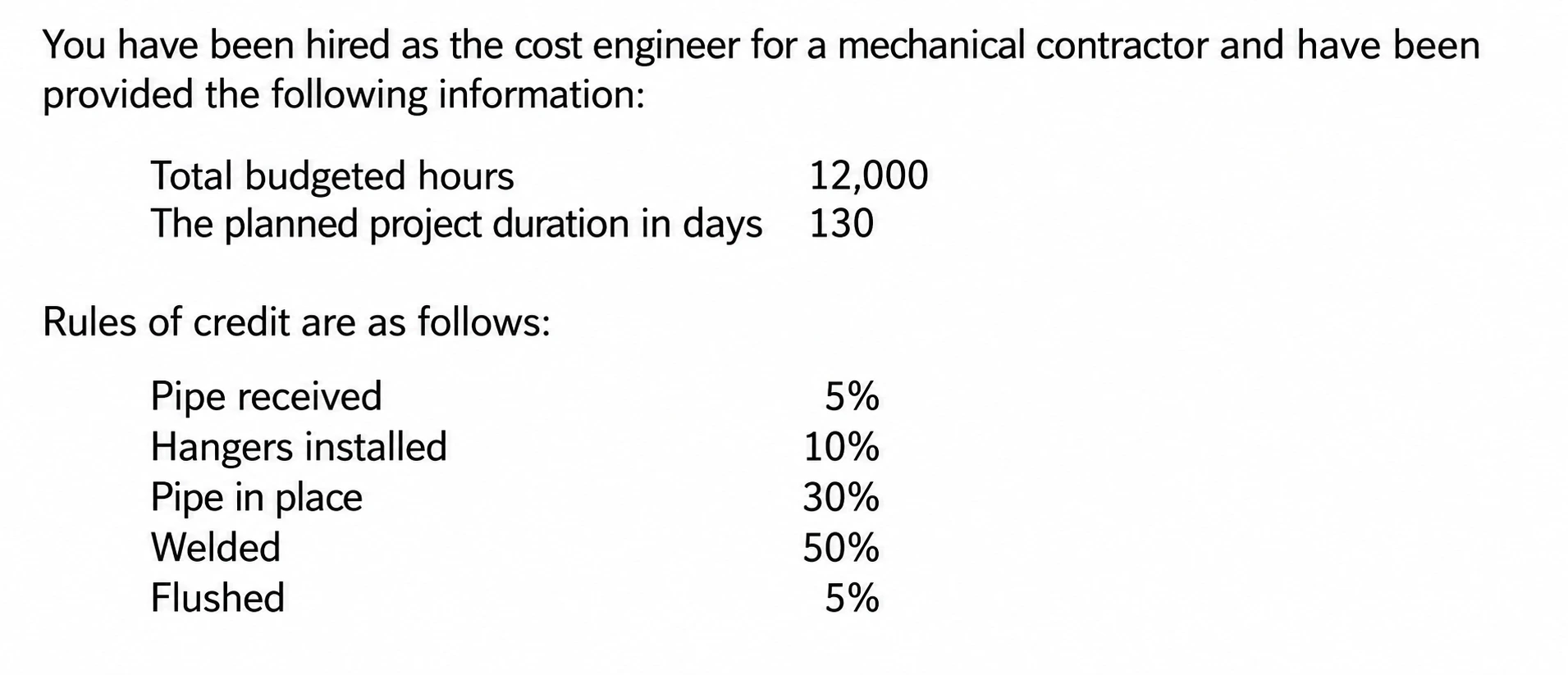
The following question requires your selection of CCC/CCE Scenario 2 (2.3.50.1.2) from the right side of your split screen, using the drop down menu, to reference during your response/choice of responses.
9,375 hours have been expended to date. Planned completion at this time is 75%. The project is determined to be 66% complete. What is the current cost performance index (CPI)?
Correct Answer: B
The Cost Performance Index (CPI) is calculated using the formula:
CPI=Earned Value (EV)Actual Cost (AC)\text{CPI} = \frac{\text{Earned Value (EV)}}{\text{Actual Cost (AC)}}CPI=Actual Cost (AC)Earned Value (EV)
Where:
EV (Earned Value) is the percentage of completion multiplied by the total budgeted hours.
AC (Actual Cost) is the total hours expended.
Given:
Total Budgeted Hours = 12,000 hours
Percent Complete = 66%
Actual Hours Expended (AC) = 9,375 hours
EV=12,000×0.66=7,920 hours\text{EV} = 12,000 \times 0.66 = 7,920 \text{ hours}EV=12,000×0.66=7,920 hours CPI=7,9209,375≈0.84\text{CPI} = \frac{7,920}{9,375} \approx 0.84CPI=9,3757,920≈0.84
So, the correct answer is B. 0.84