Certified Cost Professional (CCP) CCP Exam Questions
Preparing for the CCP exam is simple with ITPrepCerts. We offer easy-to-understand study materials that help you learn the most important exam topics. You can study using our PDF questions, practice online with a real exam-style test, or use the desktop practice software. Choose the study method that works best for you and prepare at your own pace.
At ITPrepCerts, we keep our CCP practice questions up to date. Whenever the exam syllabus or objectives change, we update our study materials so you always learn the latest topics. This helps you save time, avoid outdated content, and feel more confident when you take your exam.
A major theme park is expanding the existing facility over a five-year period. The design phase will be completed one year after the contract is awarded. Major engineering drawings will be finalized two years after the design contract is awarded and construction will begin three years after the award of the design contract. New, unique ride technology will be used and an estimate will need to be developed to identify these costs that have no historical data.
The following question requires your selection of CCC/CCE Scenario 26 (2.5.50.1.2) from the right side of your split screen, using the drop down menu, to reference during your response/choice of responses.
What class of estimate is used for the preliminary design phase of a project?
Correct Answer: A
The design phase is in the preliminary stages and involves new ride technology with no historical data available.
Steps:
Determine which class of estimate is used in this context.
A Class 5 estimate, which is an order of magnitude estimate with +50%/-30% accuracy, is typically used for projects in the early design or concept stages where detailed data is unavailable.
Answer: A. Class 5 - order of magnitude estimate with +50% / -30% accuracy
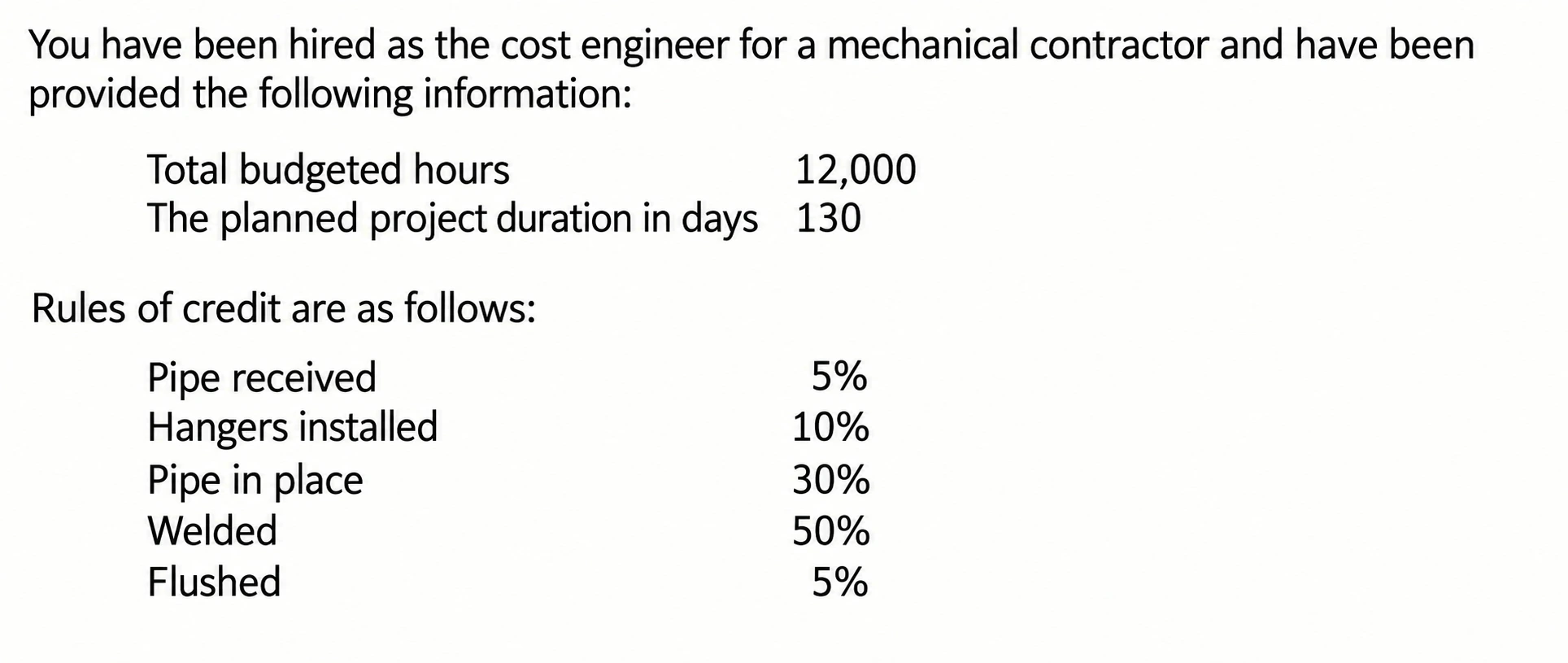
The following question requires your selection of CCC/CCE Scenario 2 (2.3.50.1.2) from the right side of your split screen, using the drop down menu, to reference during your response/choice of responses.
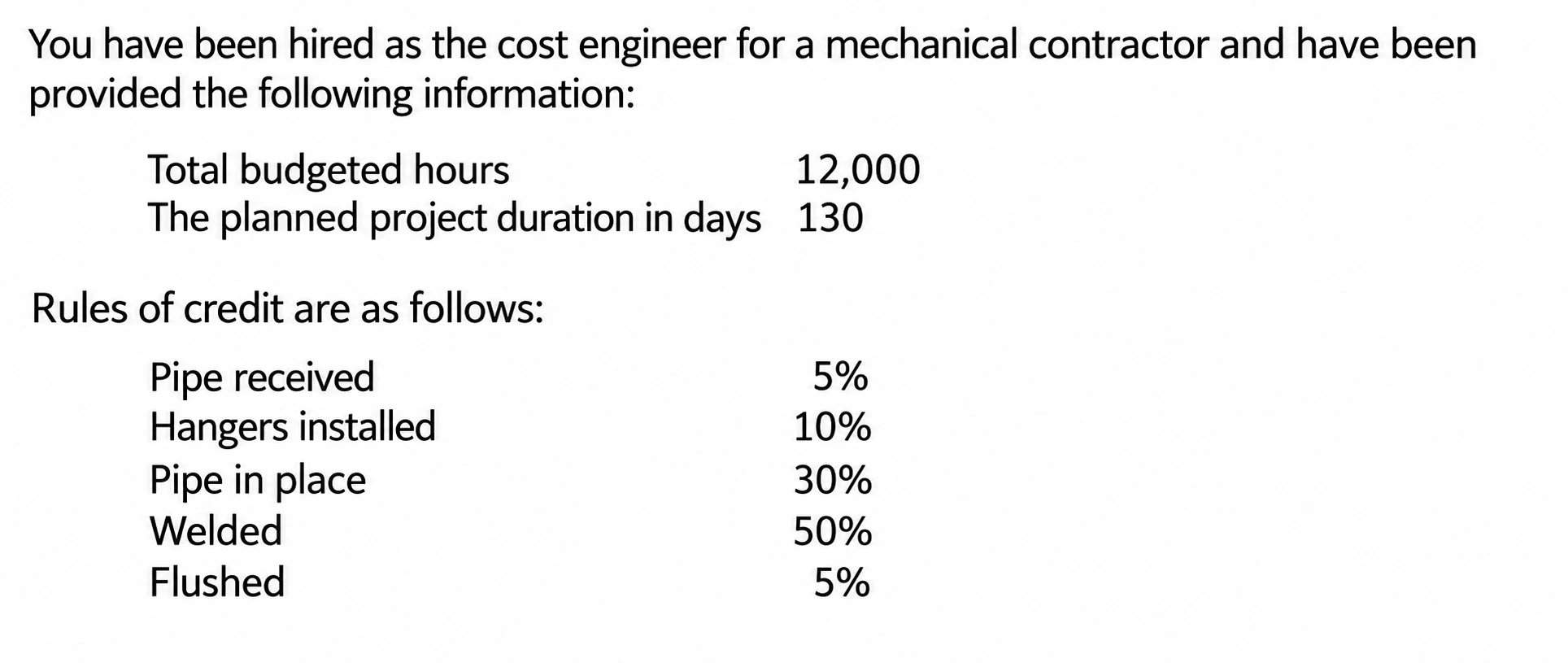
The entire pipe has been received, hangers have been installed, and all pipes are in place. None has been welded or flushed. What percent complete is this project?
Correct Answer: A
Based on the scenario where the entire pipe has been received, hangers have been installed, and all pipes are in place but none have been welded or flushed:
Pipe received: 5%
Hangers installed: 10%
Pipe in place: 30%
Adding these together gives a total percentage complete of 45% for the project. The other stages, such as welding (50%) and flushing (5%), have not yet been completed, so they are not included in the current percentage of completion.
The following question requires your selection of CCC/CCE Scenario 4 (2.7.50.1.1) from the right side of your split screen, using the drop down menu, to reference during your response/choice of responses.
At the end of Year 3, steel prices will have increased by what percentage over today's price? (round to 1 decimal)
Correct Answer: B
To calculate the total percentage increase in steel prices over three years, we compound the inflation rates for each year:
Year 1: 2.5%
Year 2: 2.5%
Year 3: 3.0%
The formula to calculate the total percentage increase is:
Total Increase=(1+Rate Year 1)×(1+Rate Year 2)×(1+Rate Year 3)−1\text{Total Increase} = (1 + \text{Rate Year 1}) \times (1 + \text{Rate Year 2}) \times (1 + \text{Rate Year 3}) - 1Total Increase=(1+Rate Year 1)×(1+Rate Year 2)×(1+Rate Year 3)−1 Total Increase=(1+0.025)×(1+0.025)×(1+0.03)−1\text{Total Increase} = (1 + 0.025) \times (1 + 0.025) \times (1 + 0.03) - 1Total Increase=(1+0.025)×(1+0.025)×(1+0.03)−1 \text{Total Increase} = 1.025 \times 1.025 \times 1.03 - 1 \approx 1.082 - 1 = 0.082 \text{ or 8.2%}
So, the correct answer is B. 8.2% .