
Databricks-Machine-Learning-Professional Databricks Databricks-Machine-Learning-Professional Exam

  • Databricks
  • 3 free sample questions

About this exam

Databricks-Machine-Learning-Professional is the Databricks exam Databricks Databricks-Machine-Learning-Professional Exam. Paid practice material for this exam is not available yet, but you can try its free sample questions.

Exam code
Databricks-Machine-Learning-Professional
Vendor
Databricks
Practice questions
Not available yet
Free sample questions
3
Question bank last updated
Not available yet

Try 2 sample questions

Taken from the free sample set for Databricks-Machine-Learning-Professional.

Question 1

A machine learning engineer is attempting to create a webhook that will trigger a Databricks Job job_id when a model version for model model transitions into any MLflow Model Registry stage.

They have the following incomplete code block:
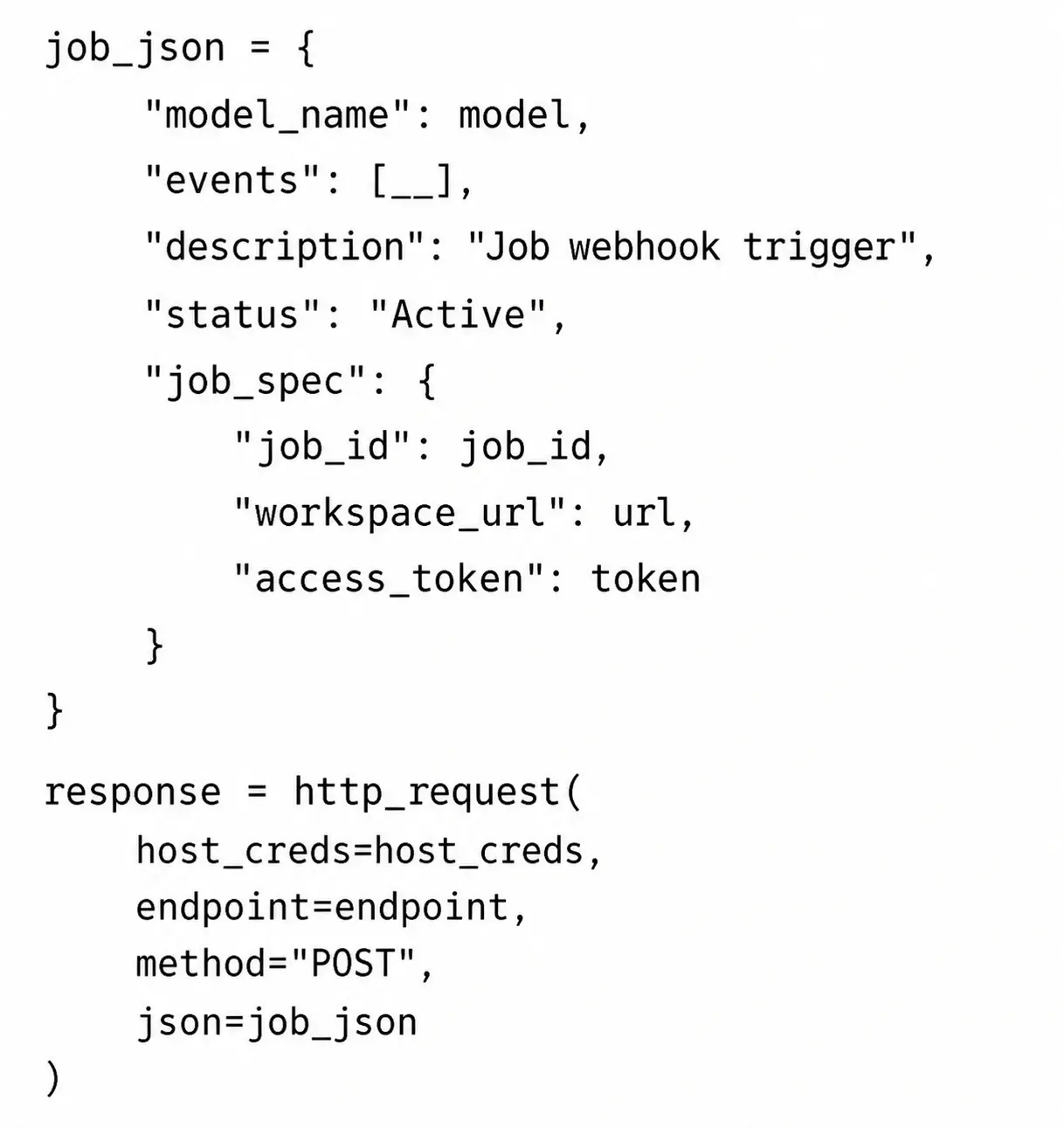
Which of the following lines of code can be used to fill in the blank so that the code block accomplishes the task?

  1. Option A:

    "MODEL_VERSION_CREATED"

  2. Option B:

    "MODEL_VERSION_TRANSITIONED_TO_PRODUCTION"

  3. Option C:

    "MODEL_VERSION_TRANSITIONED_TO_STAGING"


  4. Option D:

    "MODEL_VERSION_TRANSITIONED_STAGE"


  5. Option E:

    "MODEL_VERSION_TRANSITIONED_TO_STAGING", 

    "MODEL_VERSION_TRANSITIONED_TO_PRODUCTION"

Show answer and explanation

Correct answer: D

The correct line of code is “MODEL_VERSION_TRANSITIONED_STAGE”, which is the name of the event that occurs when a model version transitions to any stage in the MLflow Model Registry. This event can be used to trigger a webhook that will execute a Databricks Job based on the model version and the stage it transitions to. The other options are either invalid event names or too specific for the task.

References:   MLflow Model Registry Webhooks ,  MLflow Model Registry Events

Question 2

A machine learning engineer is converting a Hyperopt-based hyperparameter tuning process from manual MLflow logging to MLflow Autologging. They are trying to determine how to manage nested Hyperopt runs with MLflow Autologging.

Which of the following approaches will create a single parent run for the process and a child run for each unique combination of hyperparameter values when using Hyperopt and MLflow Autologging?

  1. Option A:

    Startinq a manual parent run before calling fmin


  2. Option B:

    Ensuring that a built-in model flavor is used for the model logging


  3. Option C:

    Starting a manual child run within the objective function


  4. Option D:

    There is no way to accomplish nested runs with MLflow Autoloqqinq and Hyperopt


  5. Option E:

    MLflow Autoloqqinq will automatically accomplish this task with Hyperopt

Show answer and explanation

Correct answer: E

MLflow Autologging is a feature that automatically logs parameters, metrics, and artifacts for machine learning frameworks, such as Hyperopt, without requiring any code changes. When using MLflow Autologging with Hyperopt, MLflow will automatically create a parent run for the hyperparameter tuning process and a child run for each unique combination of hyperparameter values. This way, the user can easily compare and visualize the results of different hyperparameter settings in the MLflow UI. MLflow Autologging also supports nested runs, which means that if the user starts a manual run before calling fmin, the parent run will be nested under the manual run. This allows the user to organize and group related runs together.  References:   MLflow Autologging ,  Hyperparameter Tuning with MLflow, Apache Spark MLlib and Hyperopt ,  Using MLFlow with Hyperopt for Automated Machine Learning ,  Parallelize hyperparameter tuning with scikit-learn and MLflow , [Optimizing Model Performance with MLflow and Hyperopt: From Hyperparameter Tuning to Serving]

See all 3 free sample questions